PRODUCTION · FINTECH · WEB
COOWN
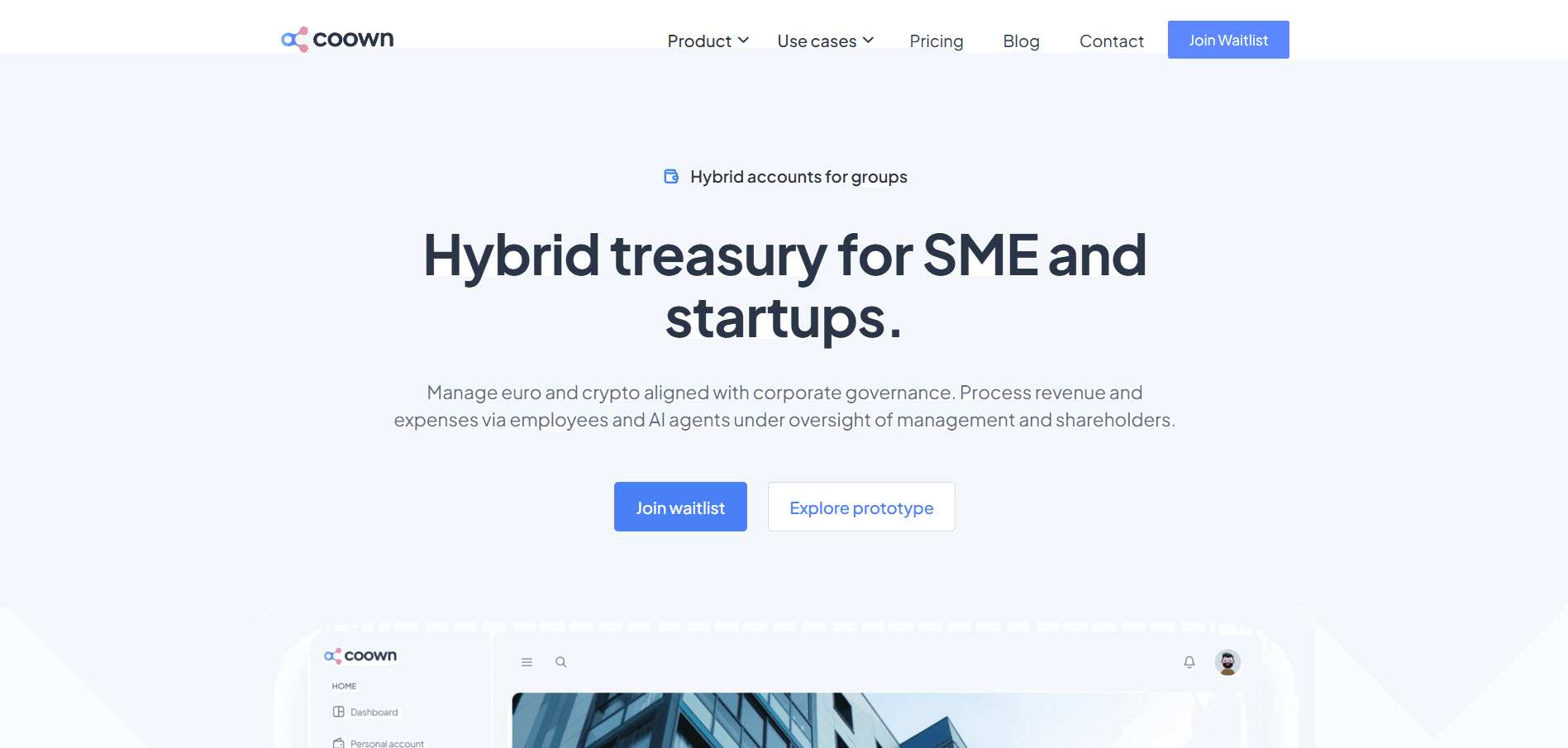
Treasury infrastructure for SMEs and startups, combining accounts, approvals, governance, invoicing, and regulated euro rails.
Role
Software Engineer — React/Vite frontend and API integration across treasury, governance, invoicing, and marketplace flows.
Period
2025–2026
Platform
Web
Primary Stack
React · TypeScript · Node.js · Supabase · MUI
The Problem
Challenge & Objectives
SMEs mix bank logins and email approvals with no enforceable roles or audit trail. Delegating spend is either too slow or too risky, especially when multiple euro accounts have to live under one set of corporate controls.
The Solution
Architectural Strategy
COOWN gives groups a treasury with programmable governance. Teams draft payments under spending caps, managers and shareholders approve high-value moves, invoices and storefronts settle into the right sub-accounts, and regulated euro rails sit behind the same controls.
My Contribution
What I implemented
I built the React/Vite treasury interface and wired it to coown-api for auth, KYC, and webhook-driven settlement on regulated euro rails.
- Built the React/Vite treasury interface for group workspaces, governance, invoicing, and marketplace.
- Integrated coown-api for auth sessions, KYC/KYB workflows, and webhook-driven settlement.
- Implemented role-based spending limits and multi-step payment approvals in the product UI.
- Wired invoicing and marketplace checkout against the Express + Supabase backend.
System Architecture
A React/Vite SPA talks to coown-api (Express + TypeScript on Supabase Postgres) for auth, groups, KYC, invoices, marketplace, and treasury state. Payments, IBAN accounts, and settlement are orchestrated through the API with webhook-driven updates — the client never talks to the rails directly.
Key Features
- 01Group workspaces with sub-accounts and department-level fund isolation
- 02Role-based spending limits, multi-step approvals, and shareholder registry
- 03KYC/KYB onboarding for regulated euro accounts
- 04Treasury with EUR transfers and IBAN activation
- 05Group invoicing with public shareable invoice links
- 06Marketplace and public storefronts with checkout
- 07Cash-flow reporting and transaction history per group
- 08Operator console for compliance, CRM, and treasury oversight
Engineering Challenges
Challenge
SMEs needed enforceable roles and an audit trail instead of bank logins mixed with email approvals.
Technical Approach
Role-based spending limits, multi-step approvals, and a shareholder registry sit in the treasury UI and API so high-value moves require the right sign-off.
Outcome
Teams draft payments under spending caps; managers and shareholders approve high-value moves under one set of corporate controls.
Challenge
Treasury state has to stay aligned with regulated euro rails, IBAN accounts, and settlement.
Technical Approach
Payments, IBAN accounts, and settlement are orchestrated through coown-api with webhook-driven updates rather than ad-hoc bank screens.
Outcome
Regulated euro rails sit behind the same workspace controls as invoicing, marketplace, and group spend.
Technology Breakdown
Frontend
- React
- TypeScript
- Vite
- MUI
Backend
- Node.js
- Express
- TypeScript
Database
- Supabase
- PostgreSQL
Integrations
- Payments
- IBAN
- Webhooks
Impact & Outcome
Live in production at coown.finance. Groups manage euro accounts, approvals, invoicing, and marketplace settlement under one set of treasury controls.
Have a project, role, or idea in mind?
Get in Touch